Your Best Page Might Be Invisible to the Machines Now Answering Your Customers

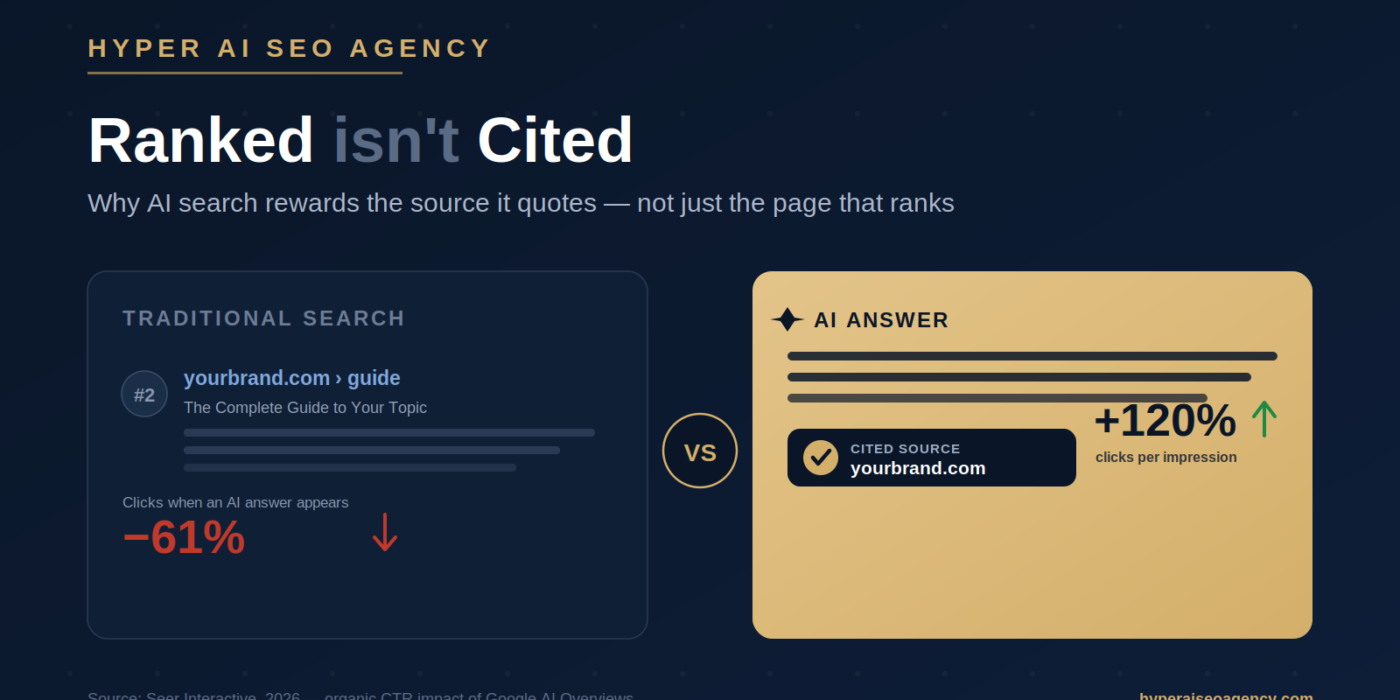
A marketing lead we spoke with earlier this year had a page she was proud of. It ranked second on Google for a valuable query, it had held that position for eighteen months, and it converted well. Then, over a single quarter, its traffic quietly fell by a third. Nothing had changed on the page. Nothing had changed in its ranking, either — it was still sitting at position two. What had changed was the search result above it: an AI Overview now answered the question before anyone reached her link.
Her page had not lost its rank. It had lost its relevance to a machine that was now doing the answering.
This is the quiet reshaping of search that every content team is living through in 2026. Google’s AI Overviews now appear on roughly half of all US search queries — Google itself has confirmed the figure sits near 50%, up from around 6.5% at the start of 2025 (BrightEdge Generative Parser, February 2026). When one of these summaries appears, organic click-through rates drop sharply: Seer Interactive’s longitudinal study of 5.47 million queries measured a fall from 1.76% to 0.61% before a partial rebound to 2.4% in early 2026 — but the gap between AI-present and AI-absent queries has settled at roughly 37% and shows every sign of being permanent.
The instinct is to panic about lost clicks. The smarter response is to change what you optimize for. Because buried in that same Seer data is the sentence that should reshape your content strategy: brands cited inside an AI Overview earn about 120% more organic clicks per impression than brands that are not. The answer engines are not destroying traffic so much as redistributing it — toward the sources they quote, and away from everyone else.
So the job is no longer only to rank. It is to be the source the machine chooses. This checklist is how you do that.
What “AI Search Content Optimization” Actually Means
AI search content optimization is the practice of structuring and writing content so that generative engines — ChatGPT, Perplexity, Gemini, Google’s AI Overviews and AI Mode, and Microsoft Copilot — can understand it, trust it, extract it cleanly, and cite it in their answers. It overlaps with traditional SEO but adds a new priority: extractability. A page can rank perfectly and still be uncitable if a machine cannot lift a clean, self-contained answer from it.
It sits alongside two related disciplines you will hear named constantly. Generative Engine Optimization (GEO) is the broad practice of earning visibility and citations inside AI-generated results. Answer Engine Optimization (AEO) is the narrower craft of structuring content so answer engines can extract precise responses. In practice they braid together, and this checklist draws on all three. The unifying idea is simple: you are now writing for a reader who may never see your page, only your sentence.
Why This Matters More in 2026 Than It Did Last Year
The scale has crossed a threshold. When AI Overviews touched a tenth of searches, ignoring them was defensible. At roughly half of all queries, and with standalone engines like ChatGPT serving hundreds of millions of weekly users, the AI answer is the search result for a large share of your audience.
Two data points make the stakes concrete. First, citation no longer tracks ranking the way it used to. In mid-2024, around 76% of AI Overview citations came from pages already ranking in Google’s top ten. By early 2026 that overlap had collapsed — BrightEdge put it as low as 17% — meaning the majority of cited sources now come from outside the classic top ten. Ranking well no longer guarantees you are quoted; it does not even make it likely on its own.
Second, the visitors who do arrive from AI are unusually valuable. Because they come pre-informed, with your brand already surfaced as part of the answer, they convert at rates several times higher than cold organic traffic — multiple 2026 analyses put AI-referred conversion well above standard organic. Fewer visits, dramatically higher intent. Being cited is not a vanity metric; it is a pipeline event.
Put together, these shifts mean the old scoreboard — rank position and raw sessions — now hides more than it reveals. The new scoreboard is citation share, and this checklist is built to move it.
The Checklist: Ten Moves That Get Your Content Cited
1. Lead With the Answer, Every Time
Answer engines scan the opening of a section most heavily, then decide in milliseconds whether to extract from it. So open every section with a direct, self-contained answer of roughly 40 to 60 words, then expand beneath it. This “answer-first” structure — sometimes called BLUF, bottom line up front — is the single highest-leverage habit in AI content. Bury your answer under three paragraphs of context and you hand the citation to a competitor who front-loaded theirs.
The discipline is uncomfortable for writers trained to build toward a conclusion. Reverse the instinct: state the claim, then justify it.
2. Make Every Passage Stand on Its Own
A paragraph that only makes sense after reading the one before it cannot be lifted into an answer. Write each block so it would still be coherent if quoted in isolation, with its own subject and enough context to be understood alone. This one habit moves more pages into citations than any technical tweak, because it matches exactly how engines assemble responses — passage by passage, not page by page.
3. Prove Expertise on the Page (E-E-A-T Is a Ranking Signal, Not a Slogan)
Experience, Expertise, Authoritativeness and Trust are signals AI engines actively weigh when choosing sources — especially on anything touching health, money or safety. Give every important page a named author with a real, credentialed bio. Show a visible publish date and, just as importantly, a last-updated date. Link out to primary sources. Cite your own first-party data where you have it. These markers are not decoration; they are the difference between being trusted enough to quote and being passed over.
4. Feed the Machines Evidence, Not Adjectives
AI engines favour specificity. “GEO improves visibility” is weak; “structured formatting and statistics can lift AI visibility by up to 40% (Princeton GEO research)” is citable. Aim for two to three concrete, attributed data points per few hundred words — numbers, named sources, dates. Original statistics you own are the strongest of all, because they exist nowhere else and give an engine a reason to name you specifically.
5. Use Structures AI Can Read
Comparison tables, numbered steps and clearly-headed FAQ sections are cited disproportionately often, because they map cleanly onto how answers are built. Where a comparison genuinely aids understanding, use a table. Where a process has stages, number them. A well-built FAQ with question-shaped headings frequently becomes the exact text an engine reuses.
Here is where the surfaces differ, and how to serve each:
| AI Surface | What It Rewards Most | The Practical Move |
|---|---|---|
| Google AI Overviews / AI Mode | Organic authority, freshness, clean extractable passages | Strong SEO foundation plus answer-first structure and schema |
| ChatGPT (Search) | Domain reputation, readability, Bing’s index | Submit to Bing Webmaster Tools; write for clarity and density |
| Perplexity | Fresh, citation-dense, well-sourced content | Keep pages current; pack in attributed evidence |
| Gemini | Google ranking signals (it inherits the infrastructure) | Win the organic fundamentals; they carry over |
| Microsoft Copilot | Bing index and authority signals | Bing indexing plus clear, structured answers |
6. Get the Technical Layer Right — Or Nothing Else Counts
If an AI crawler cannot reach or render your page, it cannot cite you, full stop. Blocked pages are invisible regardless of quality. So confirm your important content is crawlable and not locked behind scripts or PDFs, keep pages fast (Core Web Vitals still matter), and use clean semantic HTML. Then add JSON-LD schema that names your author, dates, content type and the entities you discuss — schema is a direct line into how a machine understands and classifies your page.
7. Optimize Deliberately for Each Platform
One page can serve every engine, but only if you understand what each rewards. The table above is your map. The most-skipped, highest-return step: submit your site to Bing Webmaster Tools. ChatGPT’s search retrieval leans on Bing’s index, so a site absent from Bing is invisible to a huge share of AI search — and most teams never think to check.
8. Keep It Fresh on a Schedule
Recency is now a ranking-and-citation factor. Content refreshed recently earns materially more AI citations than stale pages, and analyses of AI Overview citations show a heavy skew toward content from the last couple of years. Build an update cadence into your editorial calendar — revisit priority pages on a fixed rhythm, refresh the data, and update the “last modified” date honestly. Freshness is a habit, not a one-off.
9. Build the Entity Behind the Content
AI engines run on entities — recognised “things” — not just keywords. The more consistently your brand, authors and products appear across authoritative sources, structured databases and credible third-party mentions, the more readily an engine recognises and trusts you. On-page, that means consistent naming and structured data. Off-page, it means earning mentions where your industry is discussed. Entity authority is, in effect, the new PageRank of AI search.
10. Measure Citation Share, Not Just Rankings
You cannot improve what you cannot see, and classic rank trackers were built for blue links, not synthesized answers. Establish a baseline: take your 20 to 30 highest-intent queries and run them through ChatGPT, Perplexity, Gemini and Google’s AI Mode by hand, recording where you appear and where a competitor does instead. Pair that manual test with a dedicated AI-visibility tool, and track the trend over time. Citation share is the number that now predicts revenue.
A Real-World Pattern: From Absent to Cited
The path plays out consistently. A B2B services brand we worked with was ranking respectably but appeared in almost none of the AI answers for its category — a manual test across thirty priority prompts found it named only twice. The work was not glamorous: rewrite the top pages answer-first, add credentialed authors and dates, inject original benchmark data the competitors did not have, mark everything up with schema, submit to Bing, and set a monthly refresh rhythm. Within roughly eight to ten weeks, the same thirty-prompt test told a different story — the brand was surfacing across a meaningful share of them, and the AI-referred visitors it earned converted well above its organic average.
Nothing about that is magic. It is the checklist, applied with discipline, and measured honestly.
What This Means for Your Next Quarter
If your organic traffic has softened while your rankings held, AI Overviews are the likely cause — and the fix is not to fight the feature but to get inside it. Prioritise ruthlessly: start with your highest-intent, highest-value pages, make them answer-first and evidence-rich, prove expertise, get them technically readable, submit to Bing, and put a measurement loop around citation share. Depth beats volume. Ten pages engineered to be cited will outperform fifty written for a search era that is ending.
The window is the real point. AI search visibility rewards first movers, because entity authority and citation share compound — the brands establishing themselves as the cited source now are building an advantage that later entrants will struggle to buy back.
Work With Hyper AI SEO Agency
At Hyper AI SEO Agency, this is the entire focus of the work: engineering content and entities to be understood, trusted and cited across ChatGPT, Perplexity, Gemini, Google AI Overviews and Copilot — and measuring success by citation share and conversions, not vanity rankings. If you want to know exactly which AI answers you already appear in and which a competitor owns, our free AI visibility audit maps it in days and shows you the highest-leverage fixes first. Start with the audit and become the answer, not the afterthought.
Frequently Asked Questions
What is AI search content optimization?
It is the practice of writing and structuring content so generative engines like ChatGPT, Perplexity, Gemini and Google AI Overviews can understand, trust and cite it in their answers. It builds on traditional SEO but adds extractability — making sure a machine can lift a clean, self-contained answer from your page.
How is this different from traditional SEO?
Traditional SEO optimizes to rank a page and earn a click. AI search optimization adds the goal of being cited inside an AI-generated answer, which depends on structure, evidence, entity authority and freshness as much as on ranking. The fundamentals still matter; extractability and citation are the new layer on top.
Do Google rankings still matter in 2026?
Yes, but less exclusively. Rankings still drive clicks on queries without AI Overviews and feed engines like Gemini that inherit Google’s infrastructure. But citation overlap with the top ten has fallen sharply — by early 2026 only around 17% of AI Overview citations came from top-ten pages (BrightEdge) — so ranking alone no longer guarantees visibility in AI answers.
How do I get my content cited by ChatGPT?
Make your content readable and authoritative, and make sure your site is indexed in Bing Webmaster Tools, since ChatGPT’s search retrieval leans on Bing’s index. Then write answer-first, add evidence and clear structure, and build domain reputation. Many brands are invisible to ChatGPT simply because they never submitted to Bing.
Does being cited in an AI Overview actually help if people don’t click?
Yes. Seer Interactive’s 2026 data found that brands cited inside an AI Overview earn roughly 120% more organic clicks per impression than uncited brands on the same query. Citation also builds brand authority and trust even when a specific click does not happen, and AI-referred visitors convert at notably higher rates.
How often should I update content for AI search?
Treat freshness as a scheduled habit, not a one-off. Recently updated content earns materially more AI citations, and AI Overview citations skew heavily toward content from the last couple of years. Set a fixed cadence to revisit priority pages, refresh their data and update the modified date honestly.
What tools help track AI search visibility?
Dedicated AI-visibility platforms (such as Profound and Otterly.ai), AI modules inside familiar suites (Semrush’s AI Toolkit, Ahrefs’ Brand Radar), and free starters like HubSpot’s AI Search Grader all help. The most underrated tool is a disciplined manual test: run your top queries through the major engines each month and record where you appear.
Is AI search optimization worth it for a small business?
Often more so than for large brands, because AI engines reward the clearest, most trustworthy and most relevant source rather than the biggest budget. A focused small business with genuine expertise and strong local or niche authority can win citations on specific questions that generic national pages answer poorly.
How long does it take to see results?
Structured GEO work typically shows citation gains within roughly eight to ten weeks, provided the technical foundation is sound and the content is genuinely original and evidence-rich. The timeline depends on your starting authority, your industry’s AI exposure, and how consistently you execute the checklist.
Which industries are most affected by AI search?
Exposure varies widely. Healthcare (around 88% of queries), education (83%) and B2B tech (82%) trigger AI Overviews most often, while e-commerce currently sees far fewer (BrightEdge, 2026). Higher exposure means both greater risk of click loss and greater opportunity to win citations — so the strategy should be calibrated to your vertical.