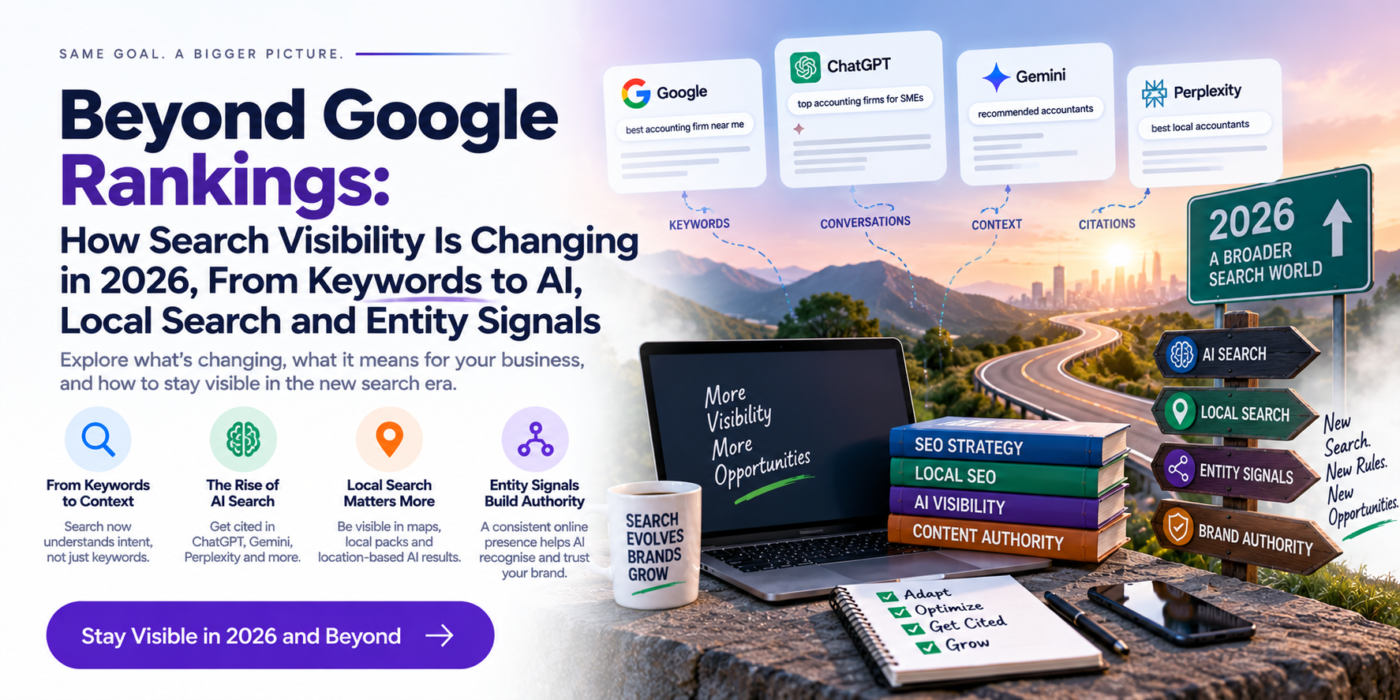
You can rank on page one and still be invisible. People now find businesses through Google Maps, AI Overviews, ChatGPT, Gemini, Claude and Perplexity, often without ever clicking a blue link. To be found in 2026 you need five things working together: sound technical SEO, a strong local presence, clear entity signals, content AI tools are willing to cite, and pages that convert. Track how often you show up, not just where you rank.
Introduction
Here is a conversation that happens in a lot of marketing meetings right now. The agency report is green. Twenty target keywords sit in the top five. And yet the phone is not ringing, the Google Business Profile gets a handful of views, and when someone asks ChatGPT for a recommendation in your city, a competitor gets named instead of you.
Nobody did anything wrong. The report just measures one place customers look, and they’ve started looking in several.
This article explains how search visibility is changing in 2026 and gives you a framework you can actually run with, from the old basics to local search, entities, AI answers and the step most teams forget: turning attention into enquiries.
How Does AI Search Work?
An AI search tool reads the question, pulls in sources it considers dependable, and writes an answer from them. It doesn’t hand you ten links. It picks a few and summarizes.
The sources that get picked tend to be clear, specific and backed up by other sites. If five reputable places describe your company the same way, a system can say so with confidence. If your details differ on every listing, it hesitates or skips you. That’s why entity SEO, topical authority and brand authority matter more than they used to.
SEO vs. GEO vs. AEO
| Traditional SEO | AEO | GEO | |
|---|---|---|---|
| What you are after | Rankings and clicks | Being the quoted answer | Being cited in AI-written answers |
| Where it shows up | Blue links | Snippets, voice, AI Overviews | ChatGPT, Gemini, Claude, Perplexity |
| What helps most | Links, relevance, site health | Short direct answers, schema, structure | Clear entity, third-party mentions, original data |
| How you measure it | Position, organic traffic | Snippet and answer share | Citation and mention share |
GEO does not replace SEO. If your site can’t be crawled properly, no amount of clever AI-focused writing will rescue it.
The Real Business Problem: Ranking Without Being Found
| What’s happening | Likely cause | What to do |
|---|---|---|
| Good rankings, few enquiries | The answer or the shortlist appears before the click | Write answer-first content and sharpen the call to action |
| Weak Google Maps presence | Incomplete profile, few reviews, inconsistent details | Fix the profile, build a review habit, add location pages |
| Never mentioned by AI tools | Unclear entity, little third-party coverage | Tighten entity signals and earn outside mentions |
| Traffic dropping, rankings steady | Zero-click results and AI Overviews | Aim for citations and branded searches, not clicks alone |
| Visitors arrive but don’t act | Pages written for crawlers, not buyers | Match the page to intent and show proof early |
A Practical Framework for 2026
Think of visibility as five layers. Each one rests on the one before it, so work through them in order.
1. Traditional SEO: Get the Foundation Right
Crawlability, speed, clean site structure, sensible internal links and genuinely useful content still decide whether any system, human or machine, can make sense of your site. It is not glamorous, but it caps everything above it. If you haven’t had a technical SEO audit lately, start there.
2. Local Search: Go After the Closest Money
For many businesses, local intent is the shortest route to revenue.
Keep your name, address and phone number identical everywhere. Build a proper page for each service and area you cover. Treat reviews as something you do every week, not a campaign you run once. Reply to them too. The words customers use in reviews often shape how AI tools describe you.
3. Entity Signals: Be Understood, Not Just Indexed
How entity signals affect SEO rankings comes down to confidence. When a search system is sure what your business is, where it operates and what it’s good at, it can match you to the right queries and trust you as a source.
Here’s where to start:
- Use the same brand and product names on your site, profiles and press mentions.
- Add structured data (Organization, LocalBusiness, Service, FAQ) wherever it genuinely fits.
- Give your leadership and authors real pages with real credentials.
- Earn mentions from trade bodies, directories and publications people trust.
4. AI Visibility: Write Something Worth Quoting
How to get cited by AI search engines is mostly a writing problem. Open with the answer. Then give the evidence: a number, a named example, a date, a source. Content that says something specific is easier to quote than content that says something safe.
How to optimize content for Google AI Overviews: use question-style subheadings, answer in the first sentence or two beneath each, add relevant schema, and cover the obvious follow-up questions on the same page.
How to improve visibility in ChatGPT search: make sure your site can be crawled by search bots, build consistent mentions on credible third-party sites, and publish honest comparison and “best for” pages. Nobody can promise a result, so test and record what changes.
5. Conversion: Make the Visibility Pay
If visibility does not produce enquiries, it is just a nice chart. Match each page to what the visitor wants, put proof near the top (case studies, reviews, credentials), and make the next step obvious. People arriving from AI answers have often done some reading already, so get to specifics quickly.
Quick win
List your five most valuable services. Ask two or three AI assistants who they would recommend for each, in your area. Wherever you’re missing, you’ve found your first priority.
Industry Use Cases
| Industry | Where visibility leaks | First move |
|---|---|---|
| Healthcare and clinics | Maps results and trust searches | Complete profiles, practitioner pages, steady reviews |
| Professional services | AI tools compare firms side by side | Original insight, named experts, case evidence |
| Home and trade services | “Near me” and urgent searches | Area pages, clear service radius, quick response |
| B2B technology | Long research cycles and AI-built shortlists | Comparison pages, solid documentation, outside citations |
ROI Analysis
Rankings alone won’t tell you whether this is working. Watch these instead:
- Share of visibility across maps, AI answers and organic results
- How often AI tools mention or cite you for your target questions
- Local actions such as calls, direction requests and bookings
- Qualified enquiries and conversion rate by source
- Revenue from journeys that started in organic or AI search
Here’s a simple example with made-up numbers, so swap in your own. Say you get 400 qualified visits a month, 3% become enquiries, and a quarter of those close at 2,000 each. That’s roughly 6,000 a month. Lift qualified visibility by 30% and conversion to 4%, and you’re at about 520 visits, 21 enquiries and 5 sales, or around 10,400. Neither change is dramatic alone, but together they nearly double the result.
Decision Framework: Where Should You Start?
- Is your site technically healthy? If not, fix that before anything else.
- Do you serve customers in a specific area? If yes, start with your Business Profile and location pages.
- Do AI tools name your competitors but not you? Work on entity signals and quotable content.
- Is there traffic but little enquiry? Look at conversion and intent before adding more content.
- Is your team stretched? A specialist partner running an AI search visibility audit can save months of guesswork.
Future Trends
- Longer, more conversational queries. People are typing full questions with context, not two-word phrases.
- Citations as currency. Being named in an answer may soon matter as much as ranking.
- Better, if imperfect, measurement. Expect new tools for tracking AI mentions, and expect them to be rough at first.
Turn Search Visibility Into a Business Growth Advantage
Rankings still count. They are just one piece now. The businesses that do well in 2026 will be the ones that are easy to understand, visible on maps, quoted by AI tools, and set up to convert the attention they earn.
Begin with an honest look at where you do and do not show up, then work through the five layers in the order that moves revenue most. If you would like help seeing where you are invisible, request an AI search visibility audit or book an AI SEO consultation with Hyper AI.
Frequently Asked Questions
1. What is AI search optimization?
It’s the work of making your content easy for AI-powered search tools to understand, trust and cite.
2. What is Generative Engine Optimization?
GEO aims at getting your brand mentioned or cited in answers generated by tools like ChatGPT, Gemini, Claude and Perplexity.
3. How does AI search work?
The tool reads the question, gathers sources it considers reliable, then writes a summarized answer, often with links.
4. What’s the difference between SEO and GEO?
SEO earns rankings and clicks. GEO earns a place inside the answer itself. The second relies on the first.
5. What is the difference between SEO and AEO?
AEO is about making content easy to lift out as a direct answer. SEO covers the wider job of relevance and ranking.
6. What are entity signals in SEO?
They’re the consistent facts about your brand, category, location and expertise that let search systems recognise who you are.
7. How do entity signals affect SEO rankings?
Clear entities help systems match you to the right searches and trust you as a source, which supports both rankings and citations.
8. How do I optimize a website for AI search in 2026?
Fix technical issues, answer questions directly, add structured data, keep your details consistent and earn mentions elsewhere.
9. How do I improve visibility in ChatGPT search?
Keep your site crawlable, publish clear answer-led pages, and build consistent mentions on sources people trust.
10. How do I get cited by AI search engines?
Publish specific, sourced, original content that opens with the answer, and update it so it stays current.
11. How do I optimize for Google AI Overviews?
Use question-based headings, answer briefly right away, add schema and cover related follow-up questions.
12. Does local SEO matter for AI search?
It does. Accurate profiles, reviews and location pages feed both map results and AI recommendations for local queries.
13. How do I measure AI search visibility?
Track mentions and citations for your target questions, local actions, branded search and conversions from organic and AI sources.
14. Can anyone guarantee a citation in AI answers?
No. These systems are not controllable. You can improve your odds through clarity, authority and consistency.
15. When should I hire an AI SEO consultant?
When rankings look fine but enquiries or AI mentions don’t, or when your team simply can’t take this on.