The Last Resort Arrived
In 2024, Sam Altman said something that aged interestingly. Asked about advertising, he called the combination of ads and AI “uniquely unsettling” and described ads as “a last resort” for OpenAI’s business model.
Two years and several hundred million users later, that last resort is a live ad platform.
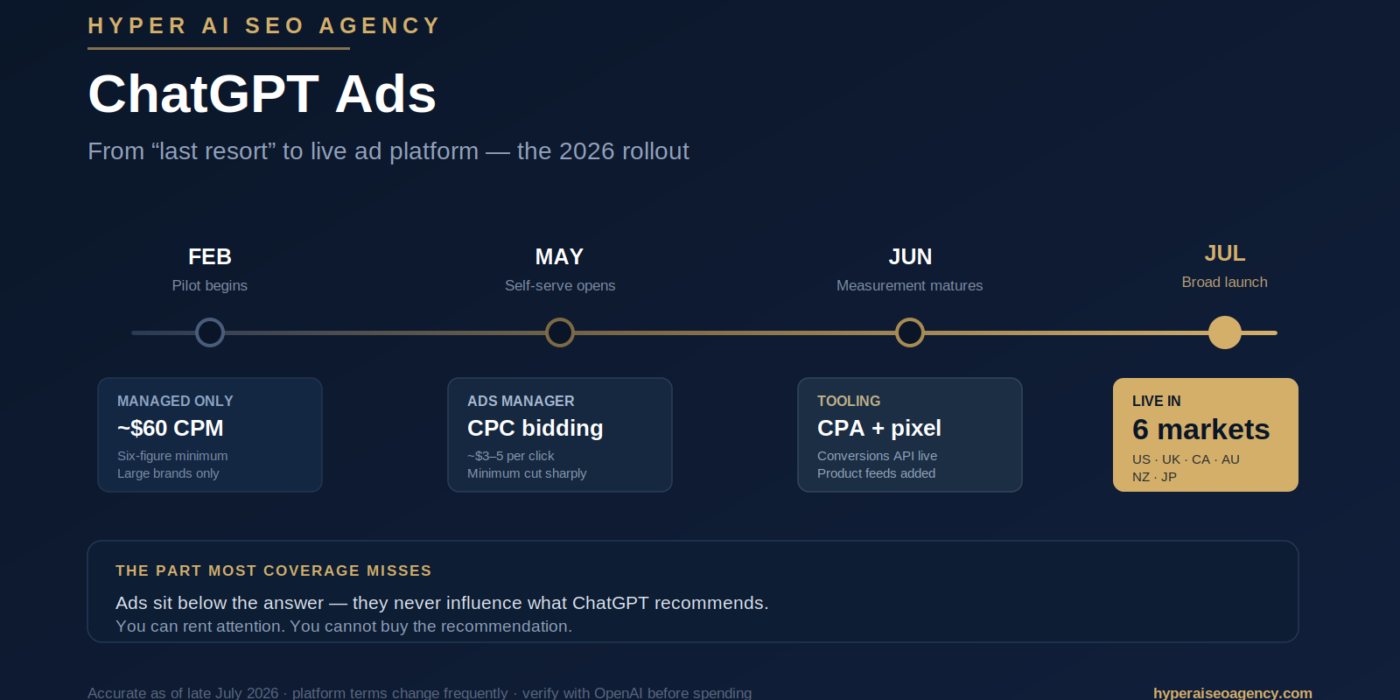
The rollout has been fast and, for marketers, a little disorienting. OpenAI began testing sponsored placements for US users in February 2026, initially through a small group of managed advertisers at roughly a $60 CPM with a six-figure minimum commitment — the kind of structure that excludes everyone except large brands. Within six weeks the pilot had reportedly generated over $100 million in revenue, which answered the question of whether advertiser demand existed.

Then in early May, the model flipped. OpenAI opened a self-serve Ads Manager to US advertisers, added cost-per-click bidding alongside CPM, and dropped the spend barrier dramatically. In late July it expanded again with a broader “Advertise in ChatGPT” launch, with Best Buy, Lowe’s and VistaPrint among the named early advertisers. Ads are now live in six markets — the US, Canada, Australia, New Zealand, the UK and Japan.
For anyone doing performance marketing, this is the most significant new ad inventory since search advertising itself. This guide covers how it actually works, what it costs, who it suits, and — importantly — who should wait.
What ChatGPT Ads Actually Are
ChatGPT ads are sponsored placements that appear inside the ChatGPT interface, below an AI response, in a clearly labeled and visually separated unit. They do not appear inside the answer itself.
That last point matters more than any other detail in this article. OpenAI has been explicit that paid placements do not influence how ChatGPT answers questions — the organic recommendation engine and the ad system are separate. You cannot buy your way into being recommended. You can only buy a placement adjacent to the answer.
The format is deliberately minimal: a business name, an image or favicon, a headline, and a short description. There is no video, no rich media, no animation. OpenAI’s position has been that ads should not degrade the experience of using the product, and the constrained format reflects that.
Who sees them is equally specific. Ads currently show to logged-in adult users on the free and lower-cost tiers. Paying subscribers on Plus, Pro, Business, Enterprise and Edu plans remain ad-free. This is a meaningful audience consideration: if your buyers are enterprise professionals on company ChatGPT accounts, they may never see your ad at all.
How Targeting Works — and Why It’s Genuinely Different
This is where ChatGPT ads diverge most sharply from what marketers are used to, and where the real opportunity sits.
Traditional social advertising is interruption-based. Meta shows you an ad because your behavioral profile suggests you might like it, while you scroll through content you came for. Search advertising is closer to intent — you typed a query, so you get a related ad.
ChatGPT sits somewhere new. Targeting is contextual, matched to the conversation actually happening. Rather than selecting demographics or firmographics, advertisers provide “context hints” describing the kinds of conversations, topics and situations where their product is relevant. The system then matches ads to live conversational context.
The implication is that ChatGPT’s understanding of user intent is unusually rich. Someone doesn’t just type “running shoes” — they describe that they’ve started training for a half marathon, have flat feet, and their current shoes are causing knee pain. That’s a level of qualified context no keyword ever captured.
There are real limits worth knowing. Granular geographic targeting isn’t there yet — ads can use broad location context like country or region, but not the city-level precision Google Local campaigns offer. Audience syncing with your own customer lists has been on the roadmap rather than broadly available. And eligible categories have been restricted to what OpenAI considers lower-risk verticals, including household goods, local services, travel, entertainment, digital products and education.
What It Costs
Pricing has moved considerably, so treat any number as a snapshot rather than a rate card.
The February pilot was reported at around a $60 CPM with a very high minimum commitment, aimed at large brands. Following the May self-serve launch, CPC bidding arrived with reported click prices in the region of $3 to $5, and the minimum spend was cut sharply. Reporting has been inconsistent on whether the minimum was reduced to $50,000 or removed entirely — OpenAI executives indicated the threshold would be removed as the platform opened to all advertisers, and several outlets have reported no minimum, while others still cite a figure. If budget scale is a deciding factor for you, verify the current requirement directly before planning.
For context on the CPM: $60 is materially above the mid-teens CPMs typical across Meta’s platforms. Early-stage inventory in a new channel often carries a premium, and whether it’s justified depends entirely on whether the intent quality converts.
Measurement has matured quickly. A conversions pixel is live, a conversions API has rolled out, and cost-per-action bidding entered early access in June. Third-party measurement was still being worked on at last report, which is worth noting — for now, the platform largely marks its own homework.
Is ChatGPT Advertising Right for You?
Here’s my honest read, and it isn’t “yes” for everyone.
It’s worth testing if you sell in one of the eligible categories, your buyers research before purchasing, you’re comfortable operating with thin reporting and shifting rules, and you have budget you can genuinely treat as experimental. The strongest argument is intent quality: people arrive at ChatGPT to decide, not to scroll, and that’s a fundamentally better context than most display inventory.
It’s worth waiting if you’re a single-location local business — the geographic targeting isn’t precise enough yet, and traditional local search advertising will serve you better. Also wait if your audience skews toward paying ChatGPT subscribers who never see ads, if you need mature attribution to justify spend internally, or if your category isn’t currently eligible.
The trajectory argument matters regardless. OpenAI is reportedly targeting $2.5 billion in ad revenue for 2026 — small against Google’s roughly $295 billion in 2025 — but industry projections put AI-driven search advertising at around $2 billion in 2026 rising toward $26 billion by 2029, which would take it from roughly 1% to over 13% of US search ad spend. Early platform experience compounds, as anyone who learned Google Ads in 2003 or Facebook Ads in 2012 can attest.
The Strategic Point Most Coverage Misses
Here’s what I’d want a client to understand before spending anything.
Ads and organic AI visibility are separate systems, and the organic one is more valuable.
When ChatGPT recommends your brand inside an answer, that carries the weight of a trusted recommendation — the user asked, and the AI answered with your name. A sponsored unit below the answer is an advertisement, and users read it as one. Both have value, but they are not equivalent, and no amount of ad spend produces the former.
That’s why the sequencing matters. If you’re invisible in ChatGPT’s organic recommendations, ads will buy you exposure but won’t fix the underlying problem — and the moment you stop paying, you disappear again. Whereas earned AI visibility compounds and persists.
The strongest position is both: earned citations that make you the recommended answer, plus paid placement that captures additional attention in the same environment. But if you have to choose one, and most businesses do, the earned side is where the durable advantage lives. Ads are rented attention. Citations are owned authority.
How to Start, Practically
If you’ve decided to test, the setup is straightforward. You’ll create an account through OpenAI’s advertising platform, which requires business details, a tax ID, a billing method and a landing page for whatever you’re promoting.
Before you launch, do three things properly. Get your conversion tracking genuinely working — install the pixel, verify events fire, and plan for reporting that’s thinner than you’re used to. Prepare landing pages that match conversational intent rather than keyword intent, because someone arriving from a nuanced AI conversation expects specificity, not a generic product page. And set a test budget you can afford to learn from, with a defined window and a clear success metric before you spend anything.
Then start small, watch actual conversions rather than platform-reported vanity metrics, and expect the rules to change under you. This platform has shifted every few weeks all year.
Work With Hyper AI SEO Agency
At Hyper AI SEO Agency, we run both halves of AI-search visibility. Our ChatGPT Ads service handles campaign setup, contextual targeting, creative and measurement inside OpenAI’s platform — while our ChatGPT SEO work builds the earned citations that get your brand recommended organically, which no ad budget can buy. Paid placement captures attention now; earned authority compounds into the recommendation itself. Start with a free AI visibility audit and let’s decide what’s actually worth your budget.
Frequently Asked Questions
Does ChatGPT have ads?
Yes. OpenAI began testing sponsored placements in February 2026 and opened a self-serve Ads Manager to US advertisers in May 2026, expanding further in July. Ads appear as clearly labeled sponsored units below AI responses, visually separated from the answer, and are live in six markets including the US, UK, Canada, Australia, New Zealand and Japan.
How much do ChatGPT ads cost?
Pricing has changed repeatedly. The February 2026 pilot was reported at roughly $60 CPM with a high minimum commitment. After the May self-serve launch, CPC bidding arrived with reported click prices around $3 to $5, and the minimum spend was cut sharply — reports differ on whether it was reduced or removed entirely. Verify current pricing with OpenAI before budgeting.
Who sees ads on ChatGPT?
Logged-in adult users on the free and lower-cost tiers. Subscribers on Plus, Pro, Business, Enterprise and Edu plans remain ad-free. This matters for audience planning: if your buyers use paid enterprise ChatGPT accounts, they may never see your ads.
Do ads influence ChatGPT’s answers?
No. OpenAI has been explicit that sponsored placements do not affect how ChatGPT answers questions. The organic recommendation system and the advertising system are separate, and ads appear below responses rather than within them. You cannot pay to be recommended in an answer.
How does ChatGPT ad targeting work?
Targeting is contextual rather than demographic. Advertisers provide “context hints” describing the conversations, topics and situations where their product is relevant, and the system matches ads to live conversational context. Granular geographic targeting and first-party audience syncing were still limited as of mid-2026.
Can small businesses advertise on ChatGPT?
Access has broadened significantly since the self-serve Ads Manager launched in May 2026, and the original six-figure minimum was cut. However, limited geographic targeting makes it a poor fit for single-location local businesses today — traditional local search advertising offers better precision for that use case.
What ad formats does ChatGPT support?
A single minimal format: business name, image or favicon, headline and short description. There is no video, rich media or animation. A product feed option was added for retail advertisers, allowing catalog uploads rather than building each ad manually.
Which categories can advertise on ChatGPT?
OpenAI restricted early eligibility to categories it considers lower risk, reported to include household goods, local services, travel, entertainment, digital products and education. Category eligibility has been expanding, so check current policy if your vertical isn’t listed.
Are ChatGPT ads better than getting cited organically?
They serve different purposes, and organic citation is generally more valuable. When ChatGPT recommends your brand inside an answer, that carries the trust of a recommendation; a sponsored unit is read as an advertisement. Ads are rented attention that stops when spending stops, while earned citations compound. The strongest position is both.
Should I test ChatGPT ads now or wait?
Test now if you’re in an eligible category, your buyers research before purchasing, and you have genuinely experimental budget plus tolerance for thin reporting. Wait if you’re a single-location local business, need mature third-party attribution, or if your audience skews toward paying subscribers who don’t see ads.