
The Deal You Lose in a Conversation You Never See
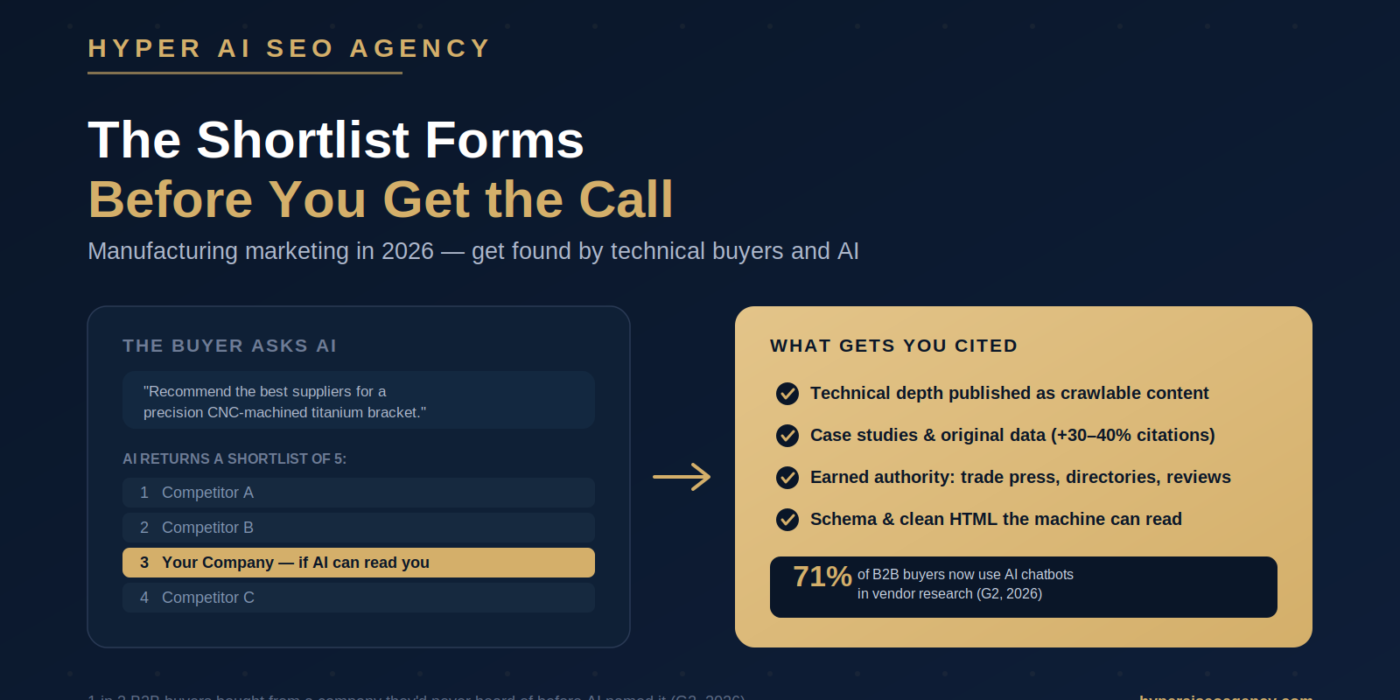
A plant engineer needs a supplier for a specialised component. Two years ago she would have opened Google, worked through a few directory listings and supplier sites, requested a couple of quotes, and started a conversation. In 2026 she opens ChatGPT and asks it to recommend the best suppliers for exactly what she needs. Ninety seconds later she has a shortlist of five names. If your company is not among them, you did not come third. You were never in the room — and your pipeline will feel completely normal right up until the quarter it does not.
This is not a hypothetical. Manufacturing has one of the longest, most considered buying journeys in business, and it is being reshaped from the front. Across a G2 study of more than 1,000 B2B buyers in 2026, 71% now use AI chatbots in their vendor research, 69% said AI guidance led them to a different vendor than they originally planned, and roughly one in three bought from a company they had never heard of before a chatbot named it. A separate procurement study found that 66% of senior B2B decision-makers now use AI tools like ChatGPT, Copilot and Perplexity to research suppliers, and 90% of them trust the recommendations these systems provide.
For manufacturers, that combination — buyers trusting AI shortlists, and being willing to buy from a name they had never heard of — is both the threat and the opening. This guide is about being the name the machine surfaces.
Why Manufacturing Is Uniquely Exposed — and Uniquely Positioned
Manufacturing sits at an unusual intersection. Its buyers are technical, its products are hard to compare at a glance, and its sales cycles involve many people. Each of those traits, which once made industrial marketing feel slow and niche, now maps directly onto how AI research works.
The dense-specification problem is the clearest example. When technical requirements are hard to compare manually, buyers lean on AI to do the synthesis. Industry analysis notes this trend is most prevalent in the SaaS and manufacturing sectors, where technical specifications are dense and difficult to compare manually. The very complexity that makes your product hard to explain is the reason buyers now ask a machine to explain it — and the machine will explain it using whoever published the clearest, most authoritative technical content.
The buying-group problem compounds it. A complex manufacturing purchase is rarely one person’s decision. Gartner and Forrester research consistently puts the B2B buying group at six to thirteen stakeholders, each doing independent research. That means your brand has to be visible and credible not to one buyer running one query, but to many people running many queries across many tools — and AI is now the connective tissue of all that research.
Here is the encouraging half. AI engines reward exactly what good manufacturers already have but usually hide: deep technical expertise, real specifications, genuine problem-solving. The firms that win are not the loudest marketers. They are the ones that made their engineering legible to both buyers and machines.
Your Technical Depth Is the Asset — Stop Hiding It
Many manufacturers bury their expertise behind thin, brochure-style marketing pages, saving the real detail for a PDF datasheet or a sales call. In an AI-research world, that instinct is backwards. The specifications, tolerances, materials data, application notes and honest problem-solving content that engineers actually want are precisely what AI engines lift and cite, because they are specific, original and authoritative.
The reason is mechanical. Research into how large language models select sources keeps landing on the same finding: specificity and evidence win. The foundational GEO research from Princeton and Georgia Tech found that adding statistics to content improves AI citation rates by 30-40%, and that citing credible sources in turn improves citation probability further. Marketing-heavy fluff does the opposite. As one 2026 manufacturing analysis put it plainly, LLMs prioritise structured data, documentation and clear technical specifications over marketing-heavy blog posts.
So the shift is concrete: take the technical depth your engineers already possess and publish it as structured, readable, on-page content rather than locking it in PDFs or behind gated forms. A page that fully answers “what tolerance can you hold on this process, and why does it matter for this application” is a page an answer engine can quote — and a buyer can trust.
Map Content to a Long, Multi-Stakeholder Journey
Because manufacturing buying groups research in stages, your content has to meet buyers at each one. The 2026 B2B buyer journey now has an extra phase bolted onto the front — an AI research phase that precedes traditional awareness, where buyers build their mental model of the category and its vendors before visiting a single website.
Early-stage buyers research problems and approaches: “how do I solve X,” “what process suits Y application.” Mid-stage they compare solutions and suppliers: “best supplier for Z,” “vendor A vs vendor B.” Late-stage they validate fit and move toward a quote. Content for each stage — explanatory guides, honest comparison and selection content, detailed capability and case pages — puts you in the answer at the moment that matters.
Comparison and selection content deserves special attention, because those queries trigger AI answers at very high rates and sit close to the buying decision. Owning detailed, honest comparison content — how your process compares to alternatives, when to choose one material or method over another — is one of the highest-leverage moves an industrial marketer can make. It is also content most competitors are too cautious to publish, which is exactly why it earns citations.
The Content That Earns Citations: Case Studies, Data, Documentation
If you do only one thing after reading this, publish your evidence. Case studies, original benchmark data, white papers and engineering write-ups are gold for AI visibility because they are evidence-rich and unique to you — they exist nowhere else on the web, which gives an engine a reason to name you specifically.
A single detailed case study showing how you solved a hard problem — the constraint, the approach, the measured result — can earn citations and credibility for years. The key is structure: lead with a clear summary, include the specific numbers, and format it so a machine can extract a clean answer. The same applies to any proprietary data you hold. If you have measured something across dozens of projects that buyers wonder about, publishing that as original research turns it into a citation magnet that lifts your whole domain.
This matters more in manufacturing than almost anywhere, because buyers use AI specifically to cut through marketing claims. Analysis of 2026 buyer behaviour found that a large majority of buying-committee members now use AI to verify vendor claims, meaning any gap between what your site says and what the wider web says about you can quietly cost you the deal. Verifiable evidence closes that gap.
Build Authority Off Your Own Site, Too
Here is the part manufacturers most often miss. AI engines lean heavily on third-party sources — trade publications, directories, distributor pages, reviews — when deciding who is credible. Your own website is necessary but not sufficient.
The data is striking. Muck Rack’s analysis of more than a million AI prompts found that over 85% of non-paid AI citations originate from earned media sources, and Ahrefs’ analysis of ChatGPT’s behaviour found that 65.3% of ChatGPT’s top-cited pages come from domains with DR80 or higher — meaning editorial authority built across the web, not just on-site polish, is the dominant factor in whether you get cited. For a manufacturer, that means presence in the trade publications, industry directories, standards discussions and credible roundups your buyers and the engines already trust. Being the recognised name for a specific capability is a durable, compounding advantage.
Fix the Technical Layer — Because the Machine Has to Read You First
None of the above matters if AI crawlers cannot parse your site. Manufacturing websites are often dated, slow, or built around locked PDFs that machines struggle to read. If an engine cannot access or interpret your capabilities, it cannot cite them, regardless of how good they are.
The fixes are usually the fastest wins available: make key technical content crawlable HTML rather than trapped in PDFs, add structured data so machines understand what your pages describe, keep pages fast, and ensure AI crawlers are not blocked. One 2026 manufacturing readiness analysis framed the gap bluntly — the difference between visible and invisible suppliers is rarely the product; it is whether the machine can read the page and trust what it finds.
Where the Pipeline Payoff Shows Up
| Old industrial marketing | AI-era manufacturing marketing |
| Brochure site, detail in PDFs and sales calls | Technical depth published as crawlable, structured content |
| Rank for a few product keywords | Get cited in AI shortlists across ChatGPT, Perplexity, Gemini |
| Authority = a few directory listings | Authority = earned media, trade press, reviews, plus on-site depth |
| Success = form fills and traffic | Success = citation share, qualified RFQs, conversion |
| One buyer, one search | Many stakeholders, many AI queries, one credible answer |
The reason this is worth the effort is the quality of what comes through. Buyers who arrive from an AI recommendation or a deep technical page come informed and serious, with you already shortlisted. Across multiple 2026 analyses, AI-referred traffic converts at several times the rate of traditional organic — one synthesis of independent studies put AI search conversion at roughly five times the rate of Google organic. Fewer, better-qualified enquiries that turn into RFQs is the whole point.
The Window Is Open, But Not Forever
There is a timing argument that should shape your urgency. AI recommendations concentrate. Procurement research found that, in many categories, just five brands capture the large majority of AI-generated recommendations — a winner-take-most dynamic more extreme than traditional search ever produced. The brands establishing that visibility now are building a position that later entrants will struggle to displace, because citation authority compounds the way domain authority did fifteen years ago.
Most manufacturers have not started. That is the opportunity. The suppliers who treat their technical expertise as publishable, machine-readable content today are quietly locking in the shortlist spots their competitors will spend years trying to win back.
Work With Hyper AI SEO Agency
Hyper AI SEO Agency builds exactly this for manufacturers and industrial suppliers: technical, evidence-led, AI-ready visibility engineered for complex, considered sales. We turn your engineering depth into crawlable, citable content, build the earned authority AI engines reward, fix the technical layer that keeps machines from reading you, and measure success by citation share and qualified RFQs — not vanity traffic. If you make something buyers research before they buy, our free AI visibility audit shows which of those research questions you already win, and which a competitor owns. Start with the audit and get your capabilities into the answer.
Frequently Asked Questions
Why do manufacturers need AI search optimization in 2026?
Because technical buyers now research suppliers with AI before contacting anyone. In a 2026 G2 study, 71% of B2B buyers used AI chatbots in vendor research and roughly a third bought from a company they’d never heard of before a chatbot named it. If your manufacturing firm isn’t visible in those AI answers, you’re absent from shortlists that form before any sales conversation.
How is AI search different from traditional SEO for manufacturers?
Traditional SEO aims to rank your pages and earn clicks. AI search optimization (GEO) aims to get your brand cited inside the answer an AI engine gives — the shortlist it recommends. It builds on SEO fundamentals but adds structured technical content, evidence-rich documentation and earned authority that make your capabilities quotable by a machine.
What content earns AI citations for manufacturers?
Specific, evidence-rich technical content: detailed specifications, application notes, case studies with real results, benchmark data and honest comparison content. Research shows adding statistics to content improves AI citation rates by 30-40%. Marketing-heavy fluff performs poorly; structured technical documentation performs well.
Should manufacturers keep technical details in PDFs?
Generally no — or not only there. AI crawlers often struggle to read content locked in PDFs, so key specifications and technical content should also live as crawlable, structured HTML on your pages. Locking your best evidence in downloadable files can make it invisible to the engines your buyers now use.
How much of manufacturing buying now happens before contacting sales?
The majority. B2B research consistently shows 60-80% of the buying journey completes before a buyer contacts a vendor, and AI tools accelerate that front-end research further. For manufacturers, this means the shortlist is often formed entirely through AI and third-party sources before your sales team knows the buyer exists.
Does off-site authority matter for AI visibility?
Significantly. Over 85% of non-paid AI citations come from earned media sources, and around 65% of ChatGPT’s most-cited pages sit on high-authority domains. For manufacturers, that means presence in trade publications, industry directories, distributor pages and reviews — not just a polished website — drives whether AI engines cite you.
How do I know if my manufacturing site is visible to AI?
Run the test yourself: ask ChatGPT, Perplexity and Google’s AI Overview to recommend a supplier in your category. One of three things happens — a competitor is named, a directory you’re not listed in is cited, or you don’t appear at all. That result is the shortlist a growing share of your buyers see. A structured audit then shows which signals to fix and in what order.
How long does AI search optimization take to show results for manufacturers?
Often faster than traditional SEO. Because the ranking signals differ, structured GEO work can show citation movement within weeks to a few months, provided the technical foundation is sound and the content is genuinely original and evidence-rich. The AI-referred RFQs that follow tend to convert quickly because those buyers arrive pre-qualified.
Do AI-referred buyers actually convert better?
Yes. Multiple 2026 analyses find AI-referred traffic converts at several times the rate of traditional organic — one synthesis put it around five times higher — because these buyers arrive pre-informed, having already evaluated you as part of the AI’s answer. For manufacturers, that means fewer but far more qualified RFQs.
Is AI search worth it for a small or niche manufacturer?
Often especially so. AI engines reward the clearest, most authoritative source for a specific capability rather than the biggest budget, and most manufacturers haven’t started optimizing. A focused, niche manufacturer that publishes genuine technical depth can own the AI answer for its specific processes and applications — a durable, compounding advantage.